
Lisbon
- Belém Tower & Monument to the Discoveries
- Tram 28 through the Alfama district
- Praça do Comércio on the Tagus riverfront
- Pastéis de nata at Belém
The train from Lisbon to Porto covers 337 km (209 miles) along Portugal's main north–south line. Alfa Pendular, Portugal's high speed train, makes the fastest Lisbon to Porto train journey in about 2h58; the conventional Intercidades train ride takes 3h15–3h23. Most trains run from Lisboa Oriente station and Lisboa Santa Apolónia station to Porto Campanhã roughly every one to two hours.

Trains run north from Lisbon along the Linha do Norte, Portugal's principal rail line, through Coimbra and Aveiro before reaching Porto. The railroad distance between the two cities covers 337 km of track — noticeably longer than the straight-line distance, since the route follows the coast and river valleys.
Alfa Pendular services typically call at only 3–4 of these stops; Intercidades trains make more intermediate stops, including smaller stations not shown here.
Lisbon and Porto anchor each end of the line, both with central, walkable city centers; Coimbra and Aveiro sit directly on it if you want a day trip stop along the same route.


Two train types run this route. Neither is objectively "better" — they trade speed for price and stop count.
| Train | Travel time | Typical fare (2nd cl.) | Stops | Departures/day |
|---|---|---|---|---|
| Intercidades | 3h15–3h23 | €27–€34 | 6–8 | ~12 |
| Alfa Pendular | 2h58–3h10 | €34–€40 | 3–4 | ~8 |
Alfa Pendular is Portugal's high speed train — a tilting train that reaches up to 220 km/h, which shortens the trip and smooths out curves on the northern section of the line; it also has a cafe-bar carriage, free Wi-Fi and a power outlet at every seat. Intercidades is a conventional, non-tilting train hauled at lower speeds with more intermediate stops; it has a cafe car but Wi-Fi and power availability are inconsistent, and the ride can be slightly noisier on tighter curves. Both offer First class (Conforto) and Second class (Turística) with reserved seating.
A few detours worth knowing about if you're not just racing between stations — charming villages and picturesque landscapes sit right along this route.

Before you even board the train, sip on a glass of Port wine along the Ribeira waterfront or take a cellar tour across the river in Vila Nova de Gaia, a great vantage point over the Douro. It's the perfect way to kick off the journey — and a fitting bookend if you're heading south toward Lisbon's own riverside sunset.

Nicknamed the "Venice of Portugal," Aveiro is a quick detour off the main line. Hop on a traditional colorful moliceiro boat to glide through the canals, then grab the local specialty — ovos moles (sweet egg pastries) — from a café by the water.

Just outside Lisbon, the wetlands along the Tagus estuary host one of Europe's largest flamingo colonies, with some of the route's best scenic views. Bring binoculars (or borrow the ones on your map!) for a peaceful stop before the bustle of the capital.
Both train types run two travel classes — First class (Conforto) and Second class (Turística). Here's what actually differs between them, seat by seat.
 Intercidades
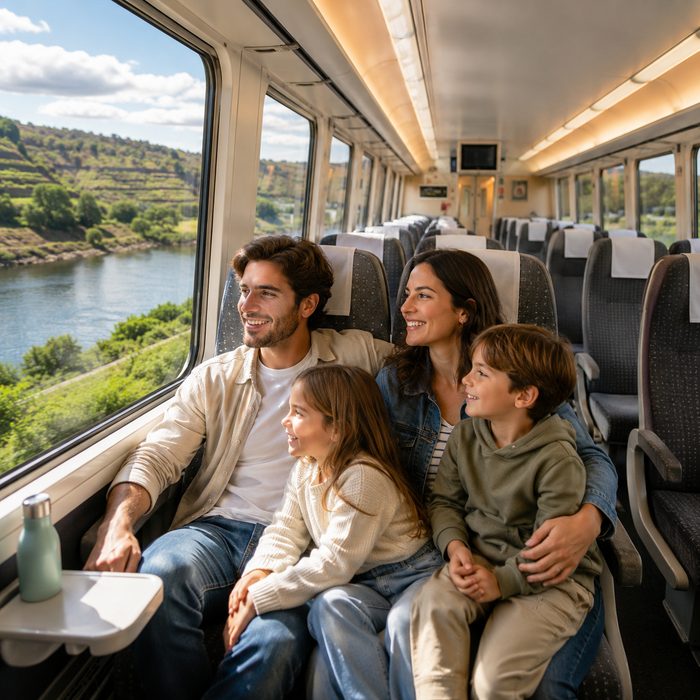 Intercidades
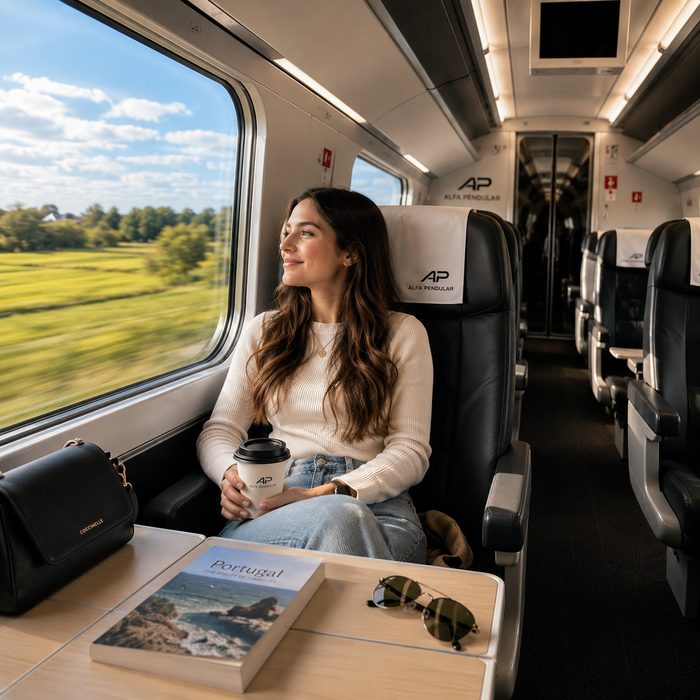 Alfa Pendular
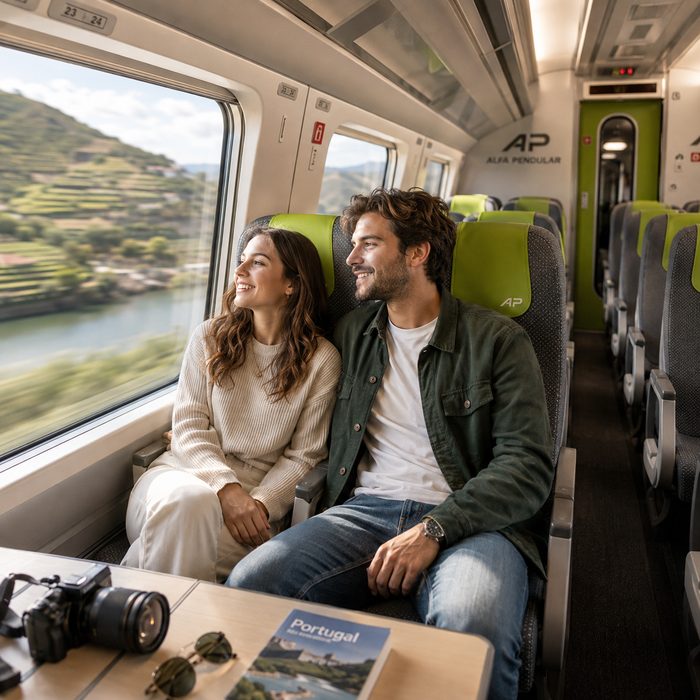 Alfa Pendular
Each city is served by two stations. Hover or tap a marker on the map for details on each one.

A sample daily departure pattern, styled after a classic station split-flap board. Tap a row to preview the stops along the line.
| Time | Destination | Train | Plat. | Status |
|---|---|---|---|---|
| 06:30 | Porto Campanhã | Alfa Pendular | 3 | On Time |
| 08:00 | Porto Campanhã | Intercidades | 5 | On Time |
| 09:30 | Porto Campanhã | Alfa Pendular | 2 | Boarding |
| 12:30 | Porto Campanhã | Intercidades | 4 | On Time |
| 14:30 | Porto Campanhã | Alfa Pendular | 3 | On Time |
| 16:00 | Porto Campanhã | Intercidades | 6 | On Time |
| 18:00 | Porto Campanhã | Alfa Pendular | 2 | Boarding |
| 19:30 | Porto Campanhã | Intercidades | 5 | On Time |
| 21:30 | Porto Campanhã | Alfa Pendular | 3 | On Time |
Sample departure pattern based on typical daily spacing — not a live board. Verify current times with the search widget above.
Factual specifics on scenery, seating and amenities — sourced from CP's own service details, not marketing copy.
The route runs along the Tagus estuary out of Lisbon, then crosses flat Ribatejo farmland — classic Portuguese countryside — and rolling countryside dotted with charming villages and cork oaks, before the final approach into Porto near the Douro valley. For the best scenic views of Portugal's stunning landscapes, take a window seat on the left side heading north.
Both train types offer Second class (Turística) and First class (Conforto) travel classes, each with assigned, reserved, comfortable seats.
Alfa Pendular has free Wi-Fi and a power outlet at every seat. Intercidades has a cafe car, but Wi-Fi and power outlet availability is inconsistent between carriages. Tickets and schedules for both are also available through the CP app.
Both trains have a cafe-bar or cafe car serving snacks and drinks; there is no full at-seat meal service on either.
There's no formal check-in if you bring luggage — bags go on the racks near your seat or at the end of each carriage, the same as most European intercity trains.
Alfa Pendular's tilting mechanism smooths out curves at speed, generally giving a quieter, steadier, more comfortable ride than the conventional, non-tilting Intercidades.
Pricing works in tiers, not a single fixed number — here's what to expect before you buy tickets.
Fares are cheapest booked in advance through Comboios de Portugal (CP), Portugal's national rail operator — booking 5 to 60 days ahead can save more than 50% off standard pricing. Travelers under 25 get a 25% discount on standard fares, and passengers 65 and older get 50% off. Single and return tickets can be bought online, through the CP app, or at the train station.
The train isn't the only way to cover this route — here's how the others compare, without steering you toward any of them.
The Alfa Pendular high-speed train covers Lisbon to Porto in about 2 hours 58 minutes at its fastest. The conventional Intercidades train takes longer, typically 3 hours 15 minutes to 3 hours 23 minutes, since it makes more stops along the way.
Yes. Both Alfa Pendular and Intercidades run direct, no-transfer services between Lisbon and Porto roughly every one to two hours throughout the day, with around 15 to 19 combined departures daily.
The ride lasts just under 3 hours on the fastest Alfa Pendular services and a little over 3 hours on Intercidades trains, covering the roughly 337 km between the two cities.
The rail route between Lisbon and Porto covers about 337 km (209 miles), running north through Coimbra and Aveiro before reaching Porto.
Second class train tickets start from around €18.50 on Regional trains, €25.25 on Intercidades, and €31.90 on Alfa Pendular when booked well in advance — standard one-way fares generally start around €27. Standard walk-up fares run higher, especially for first class.
Yes. Travelers under 25 get a 25% discount on standard fares, and passengers 65 and older get 50% off. Booking 5 to 60 days in advance can also save more than 50% compared with walk-up pricing.
Most Lisbon to Porto trains depart from Lisboa Santa Apolónia station in the city centre, calling at Lisboa Oriente station a few minutes later. Porto-bound trains arrive at Porto Campanhã station, the city's main long-distance station.
Not directly from the airport terminal. Take the Lisbon Metro red line about 10 to 15 minutes to Gare do Oriente, then board an Alfa Pendular or Intercidades service to Porto from there.
Comboios de Portugal (CP) is the national rail operator running both Alfa Pendular and Intercidades services on this route. Tickets can be bought through the CP app, on the CP website, or at the station.
Most travelers find it fast and comfortable. Alfa Pendular's tilting mechanism smooths out curves at speed, and both train types offer reserved, comfortable seats in first and second class, with free Wi-Fi and power outlets on Alfa Pendular.
Lisboa Santa Apolónia station sits in a central location on Lisbon's riverfront, at the start of the Porto route, with an easy walk into the historic centre. Tickets can be purchased online, through the CP app, or at the station, with prices that vary depending on train type and how far in advance you book.
You can buy train tickets from Lisbon to Porto online through CP, via the CP app, or at the station ticket counter — tickets can also be purchased online through the search widget near the top of this page. To book tickets and compare live fares for the same trip across different dates, use that widget directly.
Yes. The Porto route serves both Porto Campanhã, about 2.5 km from downtown, and Porto São Bento right in the historic city center. On the Lisbon side, the same Porto route gives easy access to central Lisbon from Santa Apolónia station.
The first train from Lisbon to Porto departs at approximately 06:30, with the last around 21:30. Porto departures follow a similar pattern in the evening. Departures run roughly every one to two and a half hours, keeping total journey time predictable — check the widget above for next trains and exact times.
Yes — with a journey time of under 3 hours each way on Alfa Pendular, the fastest trip option, a day trip from Lisbon to Porto by train is easy. Many travelers instead break up the same trip with a stop in Coimbra or Aveiro along the journey.
Yes, you can bring luggage on any Lisbon to Porto train journey — there's no formal check-in, just racks near your seat. Lisbon's Oriente station (also called Gare do Oriente) connects to the Lisbon Metro network, making it an easy start to the journey with bags in tow.
Not usually, once you count transfers. Air travel's total travel time compares poorly to the train once you add airport check-in and transfers on both ends; the direct train journey from city centre to city centre often edges out flying for the fastest trip when you count the full door-to-door time.